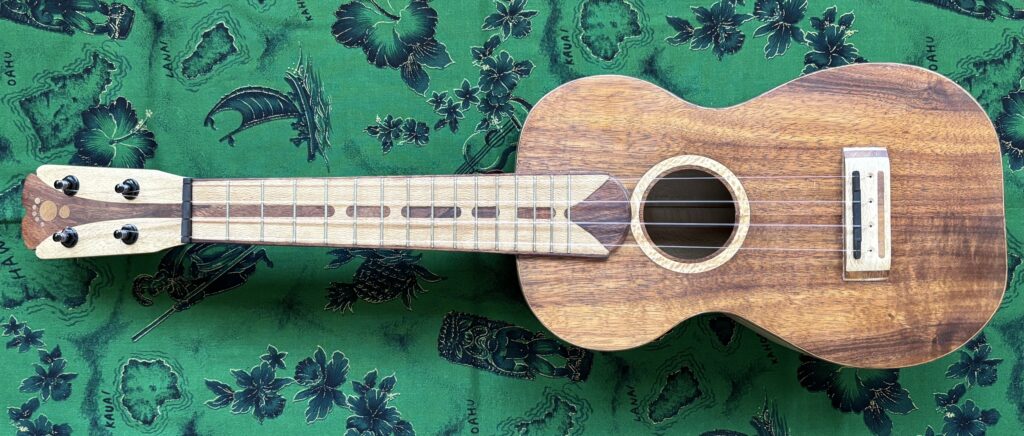
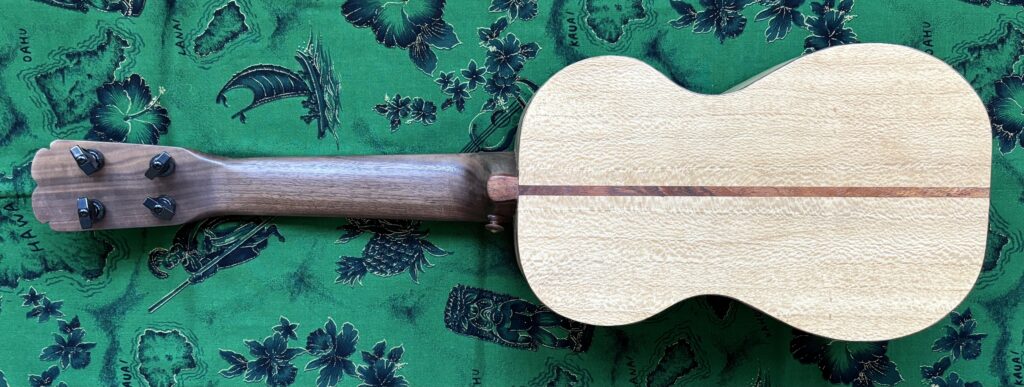
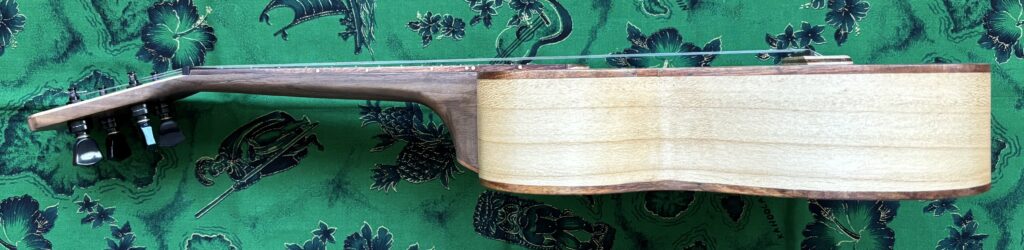
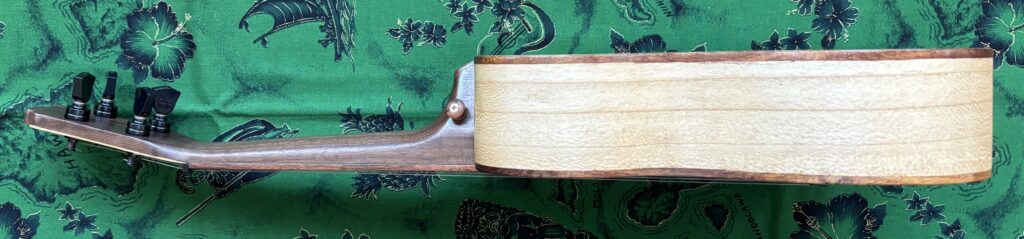
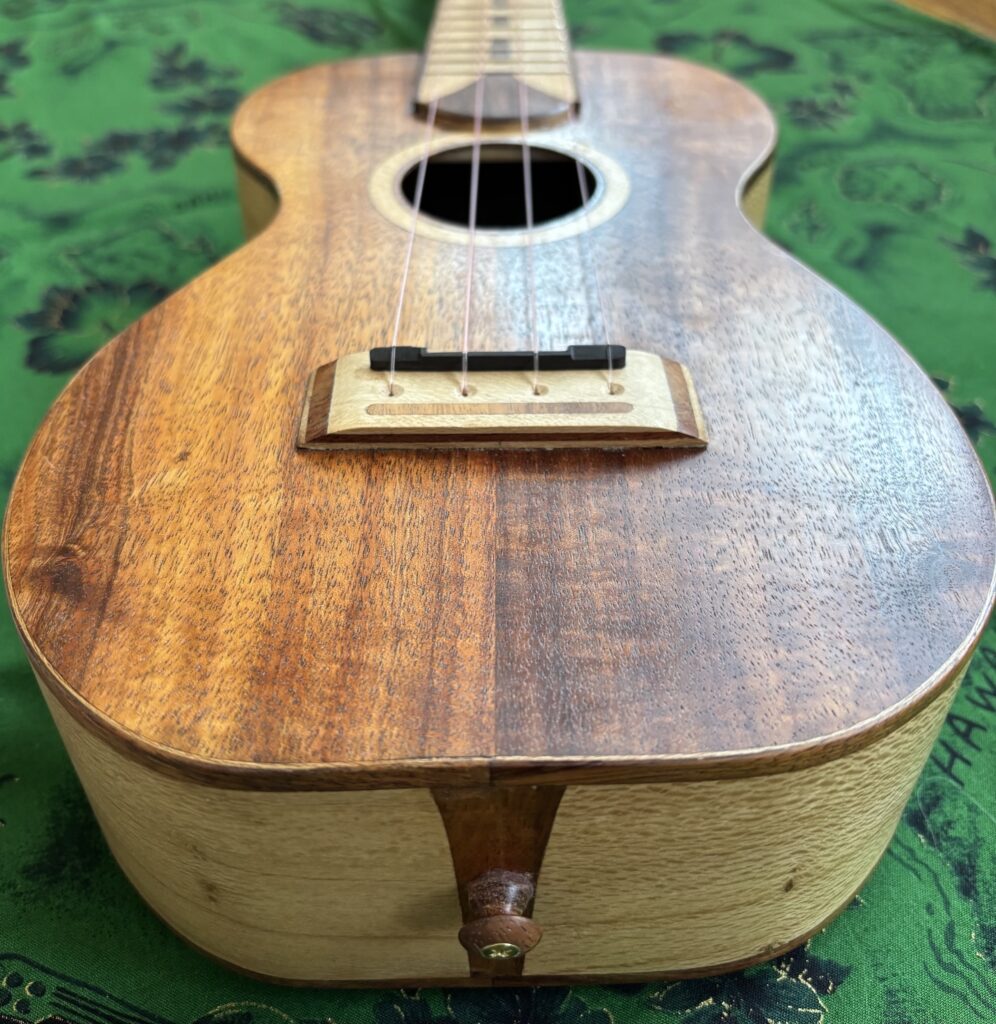
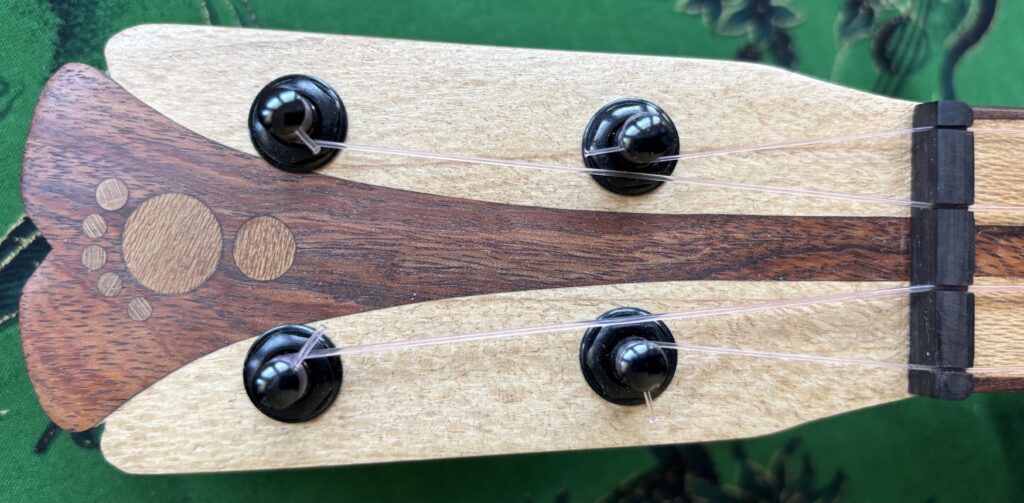
The wood used in this concert ukulele came from multiple sources. The top board and multiple other elements (binding, fretboard inlay, headstock, tail stripe, heel cap, bridge) are koa from Kanile’a Ukulele & Guitar (https://kanileaukulele.com). From my uncle, Gerry VanNess (https://gerritvannessart.com/), I got the ebony used for the saddle. The nut is ebony from a local woodworkers shop (https://www.woodcraft.com/). The sycamore (sides, headstock, fretboard, and bridge) and black walnut (neck) are from my favorite local source, Omaha Wood Co. (https://www.facebook.com/omahawoodco/). The bridge is a sandwich of sycamore (two layers) and koa. The layers are epoxied together. For a variety of reasons, I’ve started making string-through bridges, rather than tie-bar bridges.
For those of you not familiar with koa, it’s a variety of acacia that is unique to the Hawaiian islands. It has been used for over a hundred years for fine furniture and ukuleles, among other things. Koa is highly prized as a tone wood, but there are restrictions on harvesting it. Kanile’a’s koa is sustainably harvested. They have a wonderful program to reforest part of the Big Island with endemic plants and trees, including koa. Based on my understanding from interviews Joe and Kristen Souza have given, their motivation is not to provide a source of timber for their instruments; it’s to restore habitat. If I recall correctly, they’ve stated that deadfall (which is typically regarded as timber that can legitimately be harvested) serves a purpose in the lifespan of a forest, by providing microhabitats for other species. You can read more about their program at https://kanileaukulele.com/pages/savinghawaiisforests.
This uke evolved during its construction, and the evolution was the result of mishaps and complacency (something I struggle to overcome). The uke was originally meant to be all koa, except for the neck. Unfortunately, when I was bending one of the sides, it split. I believe the splitting was partly due to complex grain in the wood. I wasn’t able to stabilize the split, and I couldn’t come up with a satisfactory way of disguising the problem area. At that point, it became a koa and sycamore uke. The fact that I work on these projects in fits & starts results in not always being sure where I left off. Because of that, when I got back to assembling the body, I forgot to trim the neck end of the sides. That’s why the upper bout is unusually large. I wish I could say that was intentional. Complacency factored in to what could have been a (more) serious problem. Apparently, I didn’t tighten the nut holding the router bit to the router, which is mounted under my workbench. Shortly after I started routing the binding channel, the bit flew out of the router. In the process, it hit the side of the uke, leaving an unpleasantly noticeable dent (look closely at the upper bout in the photo below). If you’ve ever had a router bit take flight, you’ll understand when I say it’s a startling and scary experience.
The binding on the body also put up a fight with me. When I was flush trimming it, several sections of binding ripped out. I suspect the problem was due to the grain in the koa, which I do not believe was quarter-sawn. I had to remove most of the binding and start over. I still ended up with areas that I had to patch. I also decided to try adding a purfling strip of sycamore on the top. My intent was to provide some separation between the koa binding and koa soundboard. The purfling ended up being so thin it is barely visible. Live and learn! From the set I bought from Kanile’a, I have one more set of book-matched wood for a back or top. Hopefully I’ll be able to put it to good use, without as much evidence of the “hands of the maker”.
For all of the problems I experienced in building this uke, I am very pleased with how it sounds. In my sound sample below, I’ll leave it to you to see if you agree.
I have heard a lot of positive reviews of Gotoh UPT tuners, and I decided to upgrade from the Graphtech tuners I’ve used on most of my ukes. My reason for giving the UPT tuners had nothing to do with dissatisfaction with the Graphtech tuners. I have no complaints with the Graphtechs. I actually like them very much. I went with UPT tuners to see what all of the positive buzz was about. I have to admit that they’re very, very nice tuners. I’m currently debating whether to use those as my default tuners.
The ukulele is numbered 2601-13 on the label.
The components are:
Koa top (2-piece)
Sycamore back (2-piece)
Sycamore sides (2-piece)
Koa body binding, with sycamore purfling
Black walnut neck
Koa and sycamore face plate
Sycamore fretboard with koa inlay separating the fret markers (5th, 7th, 10th, 12th, and 15th frets)
Koa fretboard binding with unspecified softwood fret dots
Koa and sycamore bridge with koa inlay
Ebony nut and saddle (compensated)
Koa tail stripe
Koa heel cap
Koa back inlay
Sycamore sound hole rosette
Koa strap buttons
Sycamore headstock logo
Gotoh UPT tuners
Uke-logic fluorocarbon strings (soft tension, high G, “Sandia” pink carbon)
Tru-Oil finish
Weight: 17.3 oz. (490 g) (with strap buttons)
Nut width: 38 mm
String spacing G to A: 30 mm
Sound sample of Aloha ‘Oe (Queen Liliuokalani) and the intro & outro to Israel Kamakawiwo’ole’s version of Over the Rainbow