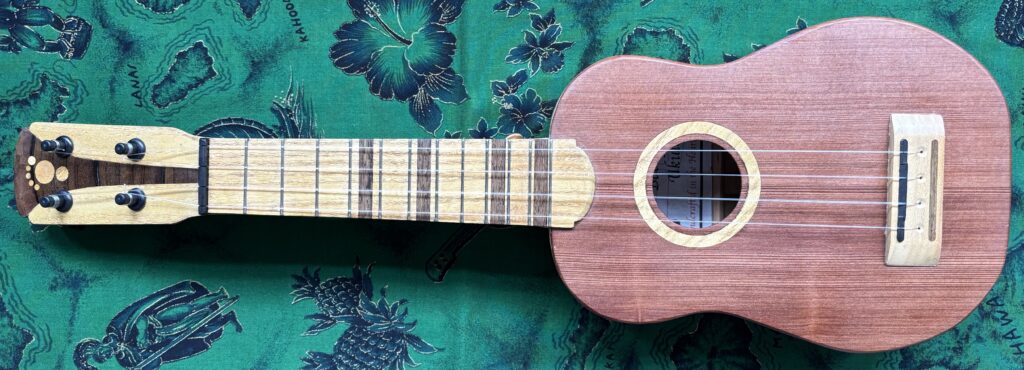
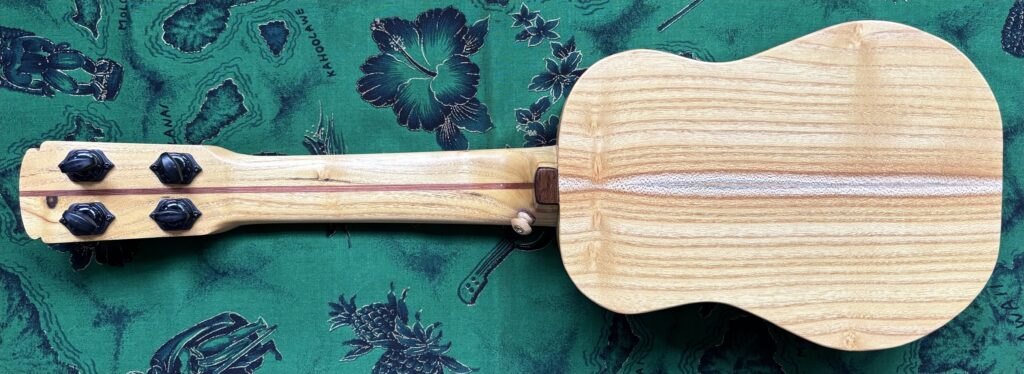
This soprano ukulele was a late entry into a raffle to support St. Jude Children’s Research Hospital. The raffle was part of the 2nd Annual Midwest Mayker Meetup in Omaha, organized by Another Woodshop Podcast and held at the Omaha Wood Co.. The uke is now in the hands of the lucky (?) raffle winners.
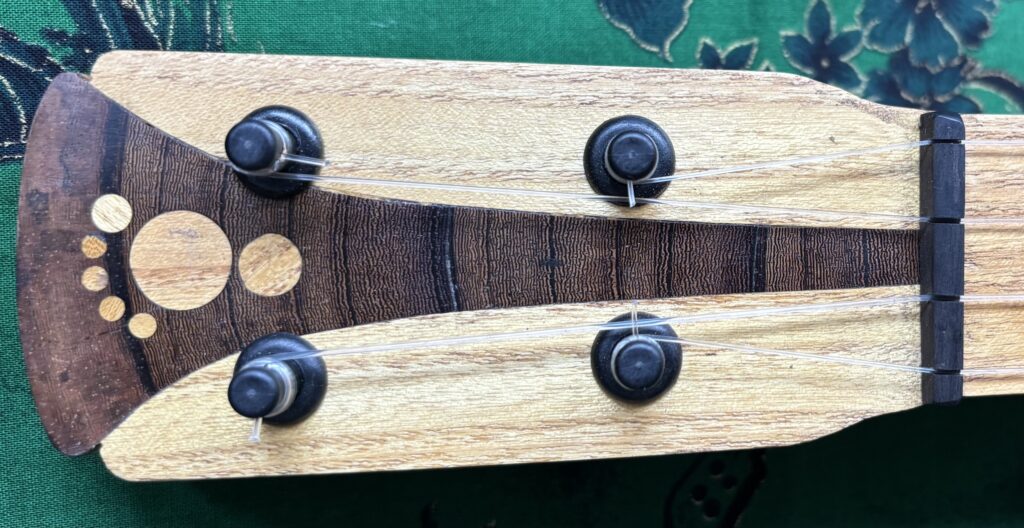
The wood used in this ukulele came from multiple sources. The top board is redwood from my in-law’s house on Oahu. Mulberry appears in multiple places (back & sides, soundhole rosette, fretboard, face plate, neck, bridge, and strap buttons) and is from my favorite local source, Omaha Wood Co. Pheasant wood in the face plate, tail stripe, heel cap, bridge inlay, and fretboard inlay is from my uncle, Gerry VanNess, as is the ebony used for the saddle. The ebony for the nut came from a local woodworker’s supply shop.
I haven’t made a point of discussing the wood I use for braces and notched kerfing. All of the ukes made to this point have used basswood. For this one, I tried something a little different. My other passion is antique clock collecting, with a focus on the clocks of Chauncey Jerome, one of the most important 19th century American clock makers. Years ago while out antiquing, I came across a door to a 19th century clock. It had a reverse-painted tablet that was in good condition, and I bought it in the event I ever needed to replace a tablet in one of my clocks. I haven’t had occasion to use the tablet, but it occurred to me that the wood used for the door frame might be suitable for ukulele braces. I’m not able to identify common soft woods just by looking at them. My guess is that it is a variety of pine, which would have been plentiful in New England. The door frame boards were all nicely quarter sawn and were easily shaped into the braces and notched kerfing. Who can say whether this was an improvement over the basswood versions?
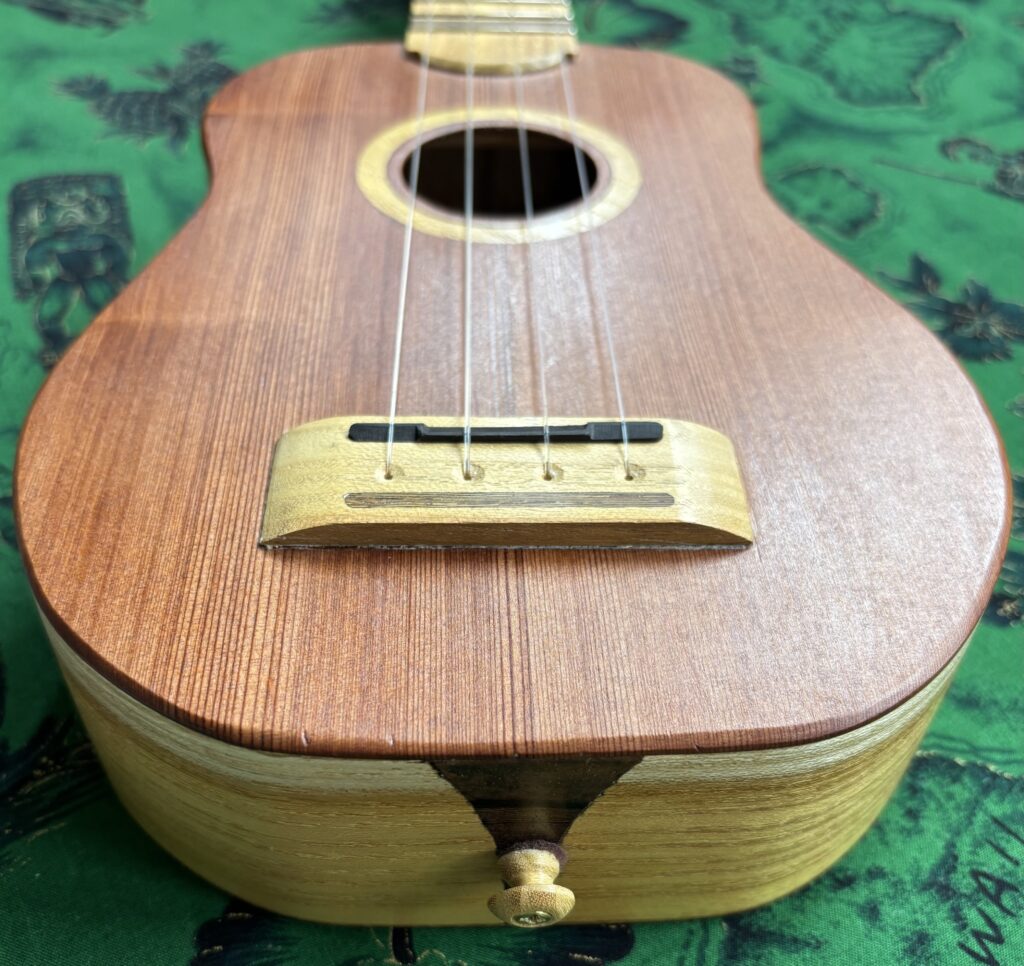
For a variety of reasons, I’ve started making string-through bridges, rather than tie-bar bridges. A tie-bar bridge is just that: the string is tied to the bridge. A string-through bridge, on the other hand, passes the string through the bridge into the interior of the ukulele. I slip a small glass bead on the string and then tie a knot in the string. When under tension, the glass bead is snugged firmly against the top board (or, more accurately, against a bridge plate glued to the underside of the top board).
Because I procrastinated, and because donation for the raffle was a spur-of-the-moment thing, I never got around to recording a sound sample.
The ukulele is numbered 2603-14 on the label.
The components are:
Redwood top (2-piece)
Mulberry back (2-piece)
Mulberry sides (2-piece)
Mulberry and redwood neck
Mulberry and pheasant wood face plate
Mulberry fretboard with pheasant wood inlay for the fret markers (5th, 7th, 10th, and 12th frets)
Mulberry bridge with pheasant wood inlay
Ebony nut and saddle (compensated)
Pheasant wood tail stripe
Pheasant wood heel cap
Mulberry sound hole rosette
Mulberry strap buttons
Mulberry headstock logo
Graphtec tune-a-lele tuners
Uke Logic fluorocarbon strings (soft tension, high G)
Tru-Oil finish
Weight: 11.7 oz. (332 g) (with strap buttons)
Nut width: 38 mm
String spacing G to A: 30 mm