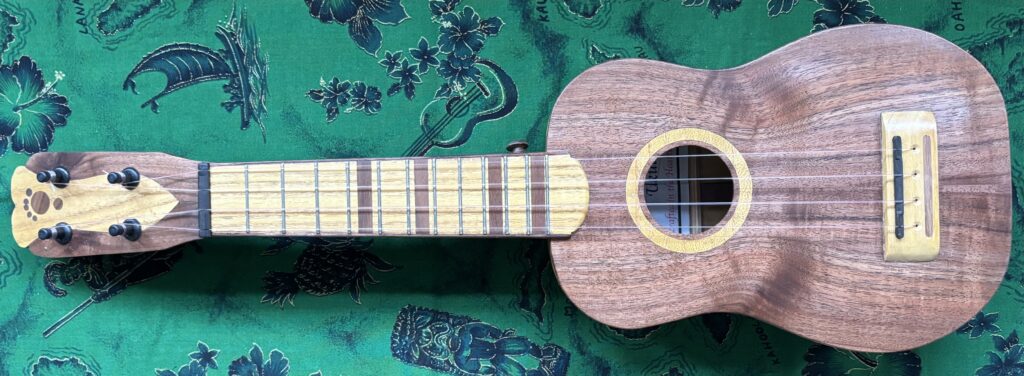
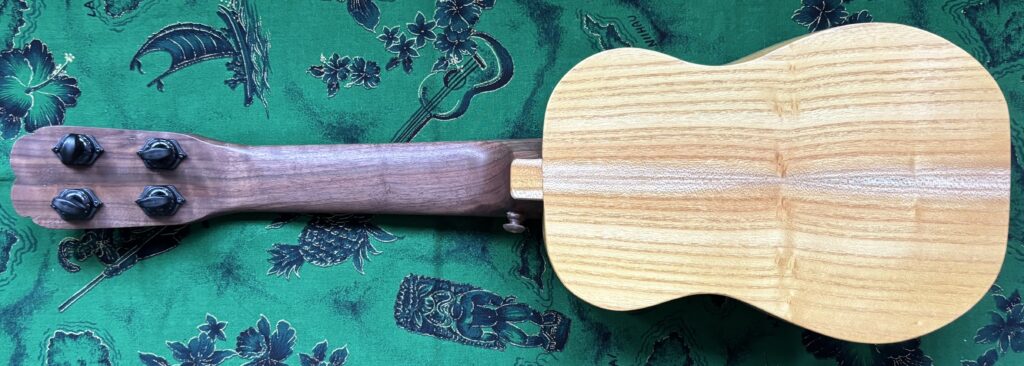
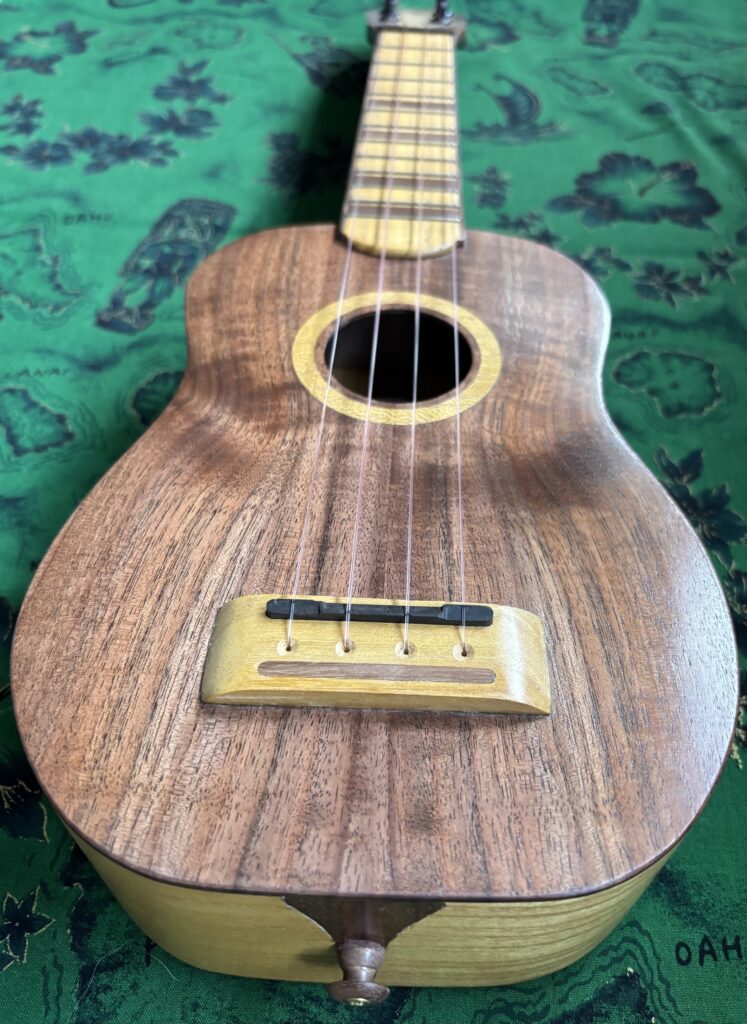
I was standing in my workshop one day trying to decide what to tackle next. I started going through some sets of wood I had cut and came across an orphan black walnut set without a matching pair for the sides. While black walnut is more commonly used for backs & sides, there are no laws against it being used for the top. Its density and hardness are similar to mahogany and koa, both of which are often used for the entire ukulele body (top, back & sides). The figuring of this set of walnut really spoke to me, so I decided I’d use it paired with mulberry back & sides. The mulberry and walnut complement each other nicely. The size of the walnut set dictated a soprano uke.
The primary woods (black walnut and mulberry) used in this ukulele came from my favorite local source, Omaha Wood Co.The ebony for the nut and saddle came from a local woodworker’s supply shop. As with the redwood-mulberry soprano, the braces are wood (possibly pine) from the frame of a salvaged 19th century clock door.
The ukulele is numbered 2607-15 on the label.
The components are:
Black walnut top (2-piece)
Mulberry back (2-piece)
Mulberry sides (2-piece)
Black walnut neck
Mulberry and black walnut face plate
Mulberry fretboard with black walnut inlay for the fret markers (5th, 7th, 10th, and 12th frets)
Mulberry bridge with black walnut inlay
Ebony nut and saddle (compensated)
Black walnut tail stripe
Mulberry heel cap
Mulberry sound hole rosette
Black walnut strap buttons
Black walnut headstock logo
Graphtec tune-a-lele tuners
Uke Logic fluorocarbon strings (soft tension, high G, “Sandia” pink carbon)
Tru-Oil finish
Weight: 13.2 oz. (375 g) (with strap buttons)
Scale length: 13 11/16 inches
Nut width: 38 mm
String spacing G to A: 30 mm
Sound samples of the intro & outro to Israel Kamakawiwo’ole’s version of Over the Rainbow and Amazing Grace